
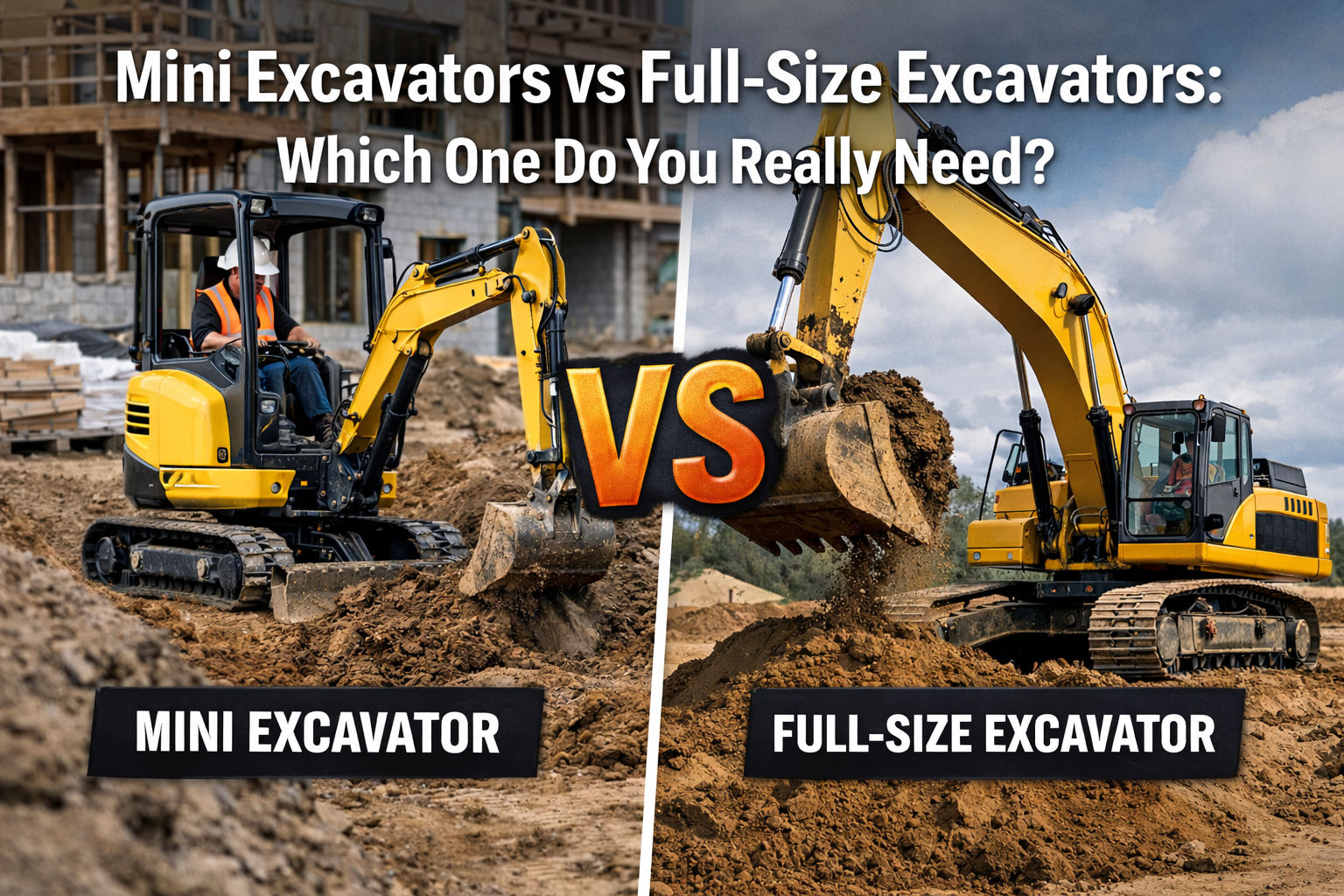
Choosing between a mini excavator and a full-size excavator is one of the most frequently mismanaged equipment decisions on construction sites — and getting it wrong can account for up to 30% of avoidable cost overruns on a project. This is not simply a question of machine size. It is a technical, financial, and operational decision that directly determines whether your project runs on time, on budget, and to the quality standard your client expects. This guide gives contractors, site managers, and project engineers the depth of analysis they need to make the right decision every time — starting with the most overlooked factor in excavator selection: the type of foundation being built.
.png)
A mini excavator (typically 1 to 6 tons) is a compact, rubber-tracked machine engineered for precision digging in constrained environments. Originally developed for urban utility trenching, today's mini excavators are sophisticated machines capable of delivering exceptional results — within the right operational parameters.
Key Technical Features:
Where Mini Excavators Excel:
Real Operational Limitations:
A full-size excavator (10 to 80+ tons) is the dominant machine in heavy construction. Built for continuous, high-volume operation, it delivers the digging force, depth capability, and bucket capacity required for serious earthmoving — particularly when foundations demand power, reach, and specialist attachments.
Key Technical Features:
Where Full-Size Excavators Are Non-Negotiable:
Real Operational Limitations:
Almost no comparison article addresses what actually determines your excavator requirements: the type of foundation you are building. The foundation transfers the entire structural load of a building into the ground — and the excavation phase is precisely where its quality is either protected or compromised. The three primary foundation types — isolated, raft, and pile — each impose fundamentally different demands on the excavation process.
| Parameter | Isolated Foundation | Raft Foundation | Pile Foundation |
|---|---|---|---|
| Structure Type | Individual column footings | Full building footprint slab | Deep load-bearing piles |
| Typical Use | Low-rise residential & light commercial | Weak/variable soil, heavy structures | High-rises, bridges, poor ground |
| Excavation Depth | Shallow — 3 to 8 ft | Medium — 4 to 12 ft | Deep — 20 to 100+ ft |
| Equipment Required | Mini excavator | Mini + full-size combined | Full-size + piling rig |
| Precision Required | High | Moderate to high | Very high |
| Optimal Excavator | Mini excavator | Both in sequence | Full-size excavator |
.png) 1. Isolated Foundation — Where Precision Beats Power
1. Isolated Foundation — Where Precision Beats Power
An isolated foundation (pad footing or spot footing) carries the concentrated load of a single structural column. It is the most common foundation type in low-rise residential construction and a significant proportion of light commercial builds.
What the Excavation Demands:
A mini excavator is the right tool here. Bucket widths match typical footing dimensions without over-excavation, zero tail swing allows safe operation between boundary walls, and quick repositioning between pit locations reduces cycle time across the full footing schedule.
Once each pit is dug, the formation layer must be compacted before concrete is placed. This is where a tamping rammer earns its place on site — compacting the base of each individual pit to the firm, stable surface the structural design assumes. Skipping this step is one of the most common causes of differential settlement on isolated footing projects.
Using a full-size excavator on isolated foundation work in confined residential conditions is one of the costliest equipment mistakes in the industry. The machine is too large to position accurately, causes excessive ground disturbance between pits, and costs 4 to 8 times more per day for a task that demands finesse, not force.
Real Project Example: A 4-storey urban apartment block on a narrow infill site uses 24 isolated column foundations. A 3.5-ton zero-tail-swing mini excavator completes all 24 pits in under 2 days, working through a 7-foot access gate between party walls. Total excavation cost: under $1,800. A full-size machine could not physically access the site.
.png) 2. Raft Foundation — Balancing Volume and Precision
2. Raft Foundation — Balancing Volume and Precision
A raft foundation (mat foundation) is a reinforced concrete slab extending across the entire building footprint. It distributes structural loads over the maximum possible ground contact area — the go-to solution when soil bearing capacity is insufficient for discrete footings.
What the Excavation Demands:
The strategic combination approach delivers its clearest value here. The full-size excavator covers bulk material removal at 200 to 400 cubic meters per day. The mini excavator achieves the edge accuracy, corner definition, and formation tolerance the structural pour requires. Sequential deployment — full-size first, mini for finish — reduces total excavation time by 30 to 50%.
On large raft projects, excavated spoil volumes are substantial. A dumper deployed alongside the excavation program keeps material moving continuously off the formation area — preventing spoil buildup around the dig zone, maintaining clear working space for the excavator, and accelerating the earthworks program. On confined urban sites where large trucks cannot manoeuvre, a tracked dumper is often the only practical solution for continuous spoil removal.
Once bulk excavation is complete and the formation surface is established, the sub-base across the full raft footprint must be uniformly compacted before blinding concrete is placed. A plate compactor is the standard tool for this task — delivering the consistent compaction density across large areas that the raft foundation design depends on.
Real Project Example: A 6-storey commercial office building on soft alluvial clay requires a raft foundation across 18,500 square feet. A 20-ton excavator removes approximately 2,800 cubic meters of bulk material over 4 days. A 5-ton mini excavator then works the perimeter, corners, and formation surface over 2 additional days, achieving the ±20mm tolerance specified by the structural engineer. Combined machine cost came in 22% below the budget estimate based on a full-size-only strategy.
.png) 3. Pile Foundation — No Compromise, No Substitution
3. Pile Foundation — No Compromise, No Substitution
A pile foundation transfers structural loads through weak surface soils to strong strata or bedrock far below. It is the foundation of choice for high-rise buildings, large bridges, port structures, and any project where the ground immediately below formation level cannot carry the imposed load.
What the Excavation Demands:
There is no nuance here. A mini excavator cannot perform pile foundation work. Rotary drilling attachments require 30+ tons of machine weight as a stable working platform. Spoil volumes in deep piling programs exceed mini excavator capability by orders of magnitude. Attempting to use undersized equipment on a pile foundation program does not save money — it prevents the work from being done at all.
Real Project Example: A 24-storey residential tower on waterlogged reclaimed land requires 450 bored concrete piles to 45 meters depth. A 60-ton excavator fitted with a rotary drilling head manages the piling program. A second 30-ton unit handles continuous spoil removal and pile cap formation. Any attempt to substitute smaller equipment would have extended the piling program by months and introduced unacceptable quality risk.
| Parameter | Mini Excavator (1–6t) | Full-Size Excavator (10–80t+) |
|---|---|---|
| Digging Depth | 6 – 14 feet | 14 – 35+ feet |
| Bucket Capacity | 0.02 – 0.10 cu yd | 0.5 – 4.0+ cu yd |
| Breakout Force | 3,000 – 12,000 lbs | 20,000 – 100,000+ lbs |
| Fuel Consumption | 1 – 3 gal/hr | 8 – 25+ gal/hr |
| Daily Rental Cost | $250 – $600 | $1,200 – $4,500+ |
| Precision Work | Excellent | Moderate |
| Bulk Productivity | Low | Very high |
| Isolated Foundation | Ideal | Overkill — avoid |
| Raft Foundation | Partial (edges and finish) | Essential (bulk removal) |
| Pile Foundation | Not suitable | Essential — no alternative |
| Tight Site Access | Excellent | Poor to impossible |
Smart contractors do not evaluate excavator options by daily rate. They evaluate by cost per cubic meter of material removed — the only metric that honestly accounts for machine rate, fuel, operator time, and daily output together.
Mini Excavator on Isolated Foundation Work (85 m³ total)
Daily rate: $400 | Fuel: $80 | Operator: $280 | Daily output: 45 m³
Cost per cubic meter: approximately $17 | Total job cost: ~$1,445 over 2 days
Full-Size Excavator on Same Isolated Foundation Job
Daily rate: $2,200 | Fuel: $380 | Operator: $380 | Daily output: 180 m³
Total job cost: ~$2,960 for a half-day mobilization minimum — 105% cost premium for no measurable benefit
Full-Size Excavator on Raft Foundation (3,400 m³)
Daily rate: $2,200 | Fuel: $380 | Operator: $380 | Daily output: 700 m³
Cost per cubic meter: approximately $4.25 | Total bulk phase: ~$14,450 over 4–5 days
Mini Excavator Only on Same Raft Foundation
Daily rate: $420 | Fuel: $85 | Operator: $280 | Daily output: 45 m³
Total job: ~$59,330 over 75+ days — 4x cost premium with catastrophic schedule impact
Environmental performance is no longer a secondary consideration. Many public sector contracts now include carbon reporting requirements, and private developers increasingly demand sustainable site management.
Where a mini excavator genuinely meets the project's operational requirements, it delivers a significantly lower carbon footprint per cubic meter — increasingly relevant to ESG reporting and project tender scoring.
Q1. Can a mini excavator dig a raft foundation?
A mini excavator can contribute to raft foundation excavation — specifically on edge trimming, corner work, and formation finishing. However, it cannot efficiently complete the bulk excavation phase. The optimal strategy is to use both machine types in sequence.
Q2. What is the maximum depth a mini excavator can reach?
Most mini excavators in the 1 to 6-ton class achieve maximum digging depths of 8 to 14 feet. Some long-arm variants can reach 16 feet. Pile foundation work, which routinely requires 20 to 100+ feet, is entirely outside mini excavator capability.
Q3. Is it cheaper to rent a mini or full-size excavator?
On a daily rate basis, a mini excavator costs significantly less — $250 to $600 per day versus $1,200 to $4,500+. However, cost per cubic meter is the correct metric. On high-volume projects, a full-size excavator frequently delivers a lower cost per cubic meter despite its higher daily rate.
Q4. When should I use both a mini and full-size excavator on the same project?
Deploy both machines when excavating a raft foundation, when a large site includes both open bulk areas and constrained access zones, or when different project phases require different capability profiles. The combination approach consistently outperforms single-machine strategies on both cost and quality.
Q5. Does foundation type really affect excavator choice that much?
Absolutely — and it is the most underappreciated factor in construction equipment selection. Foundation type determines excavation depth, precision requirements, volume, soil disturbance tolerance, and attachment needs. It is not one factor among many — it is the primary factor.
Q6. Are electric mini excavators suitable for foundation work?
Electric mini excavators are increasingly capable and suitable for isolated foundation work in noise-sensitive and emissions-restricted environments. They are not yet available in full-size classes sufficient for raft or pile foundation bulk work.
The debate between mini and full-size excavators is not really a debate at all — it is a matching exercise. The isolated foundation calls for the precision, economy, and access capability of a mini excavator. The raft foundation demands both machine classes in sequence — with a dumper keeping the formation area clear throughout bulk earthworks and a plate compactor delivering sub-base density before the structural slab is poured. The pile foundation requires the hydraulic power and depth capability of a full-size machine — and no amount of budget pressure changes that requirement.
Foundations in construction are not an area for improvisation. Choose based on what the foundation demands. Calculate the true cost per cubic meter. Conduct the site access survey before placing any equipment order. And deploy both machine types on raft foundation projects — the combination approach consistently outperforms any single-machine strategy on cost, quality, and program.
Automatic Stirrup Bending Machine: Complete Price & Buying Guide (India)
Rebar Bending Machine Price in India: Types, Capacity, Power & Complete Buying Guide
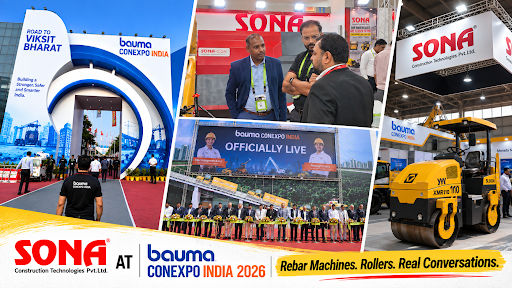
Sona at bauma CONEXPO INDIA 2026: A Look Inside Stall H14-B55
TMT Stirrup Bending: Machine Bending vs. Manual Bending — Which Is Better?
TMT Bar Cutting and Bending: Complete Guide, Methods, BBS & TMT Brands in India

Copyright © 2026 Sona Construction Technologies Private Limited