

A Practical Guide for Contractors, Civil Engineers and Site Supervisors
Have you ever removed the formwork from a concrete column, beam or wall and noticed rough patches, exposed aggregates or small cavities on the surface?
This condition is commonly known as honeycombing in concrete.
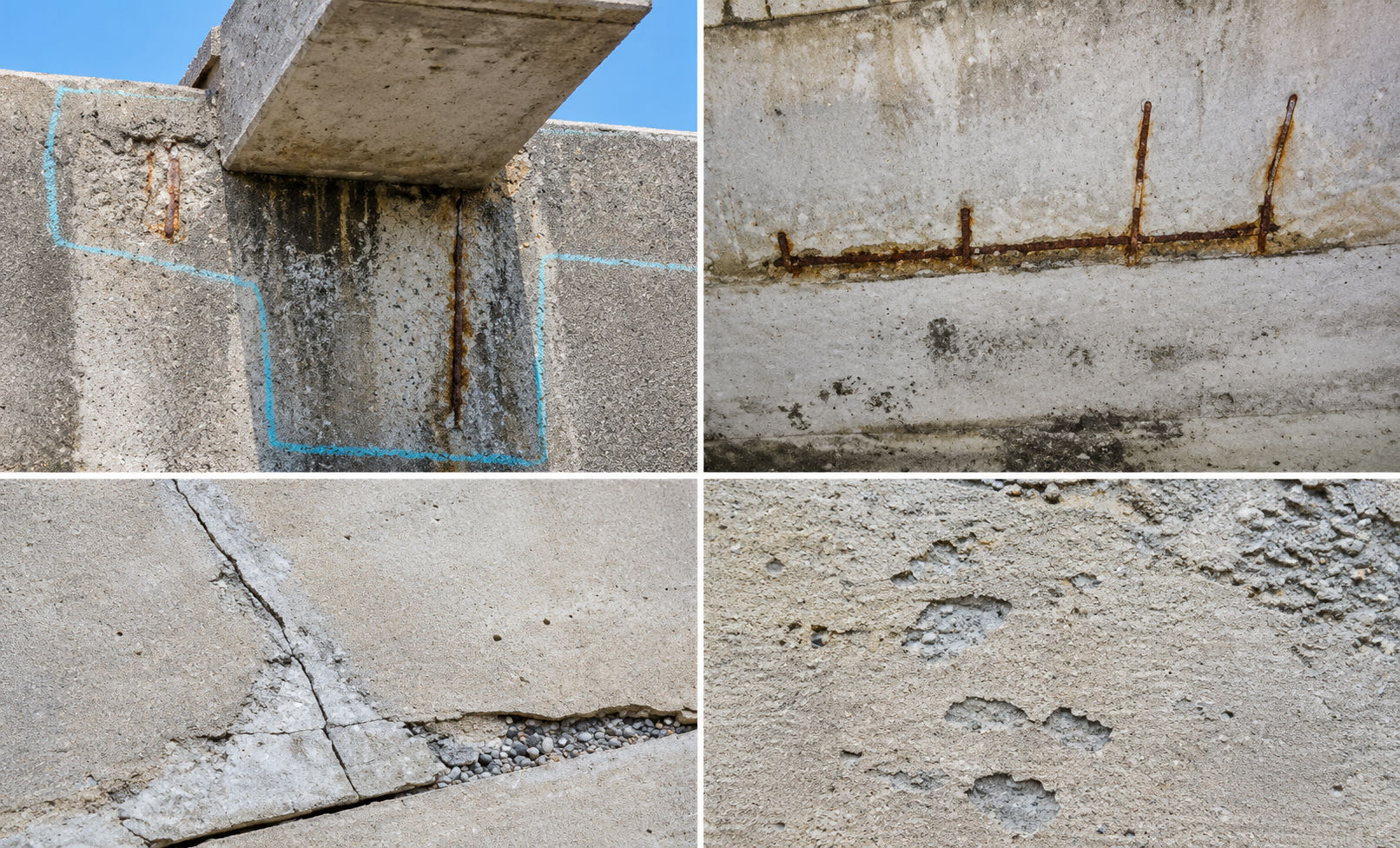
Honeycombing is a common concrete defect that occurs when concrete does not properly fill the spaces between reinforcement bars or around the formwork, leaving voids and exposed coarse aggregates.
While minor surface imperfections may be repairable, deeper honeycombing can affect concrete durability, reinforcement protection and, in severe cases, structural performance.
For contractors and site engineers, understanding why honeycombing occurs is important for maintaining concrete quality and avoiding expensive rework.
In this guide, we will explain the major causes of concrete honeycombing, how to prevent it during pouring, the correct use of needle vibrators and what to do when the defect is identified.
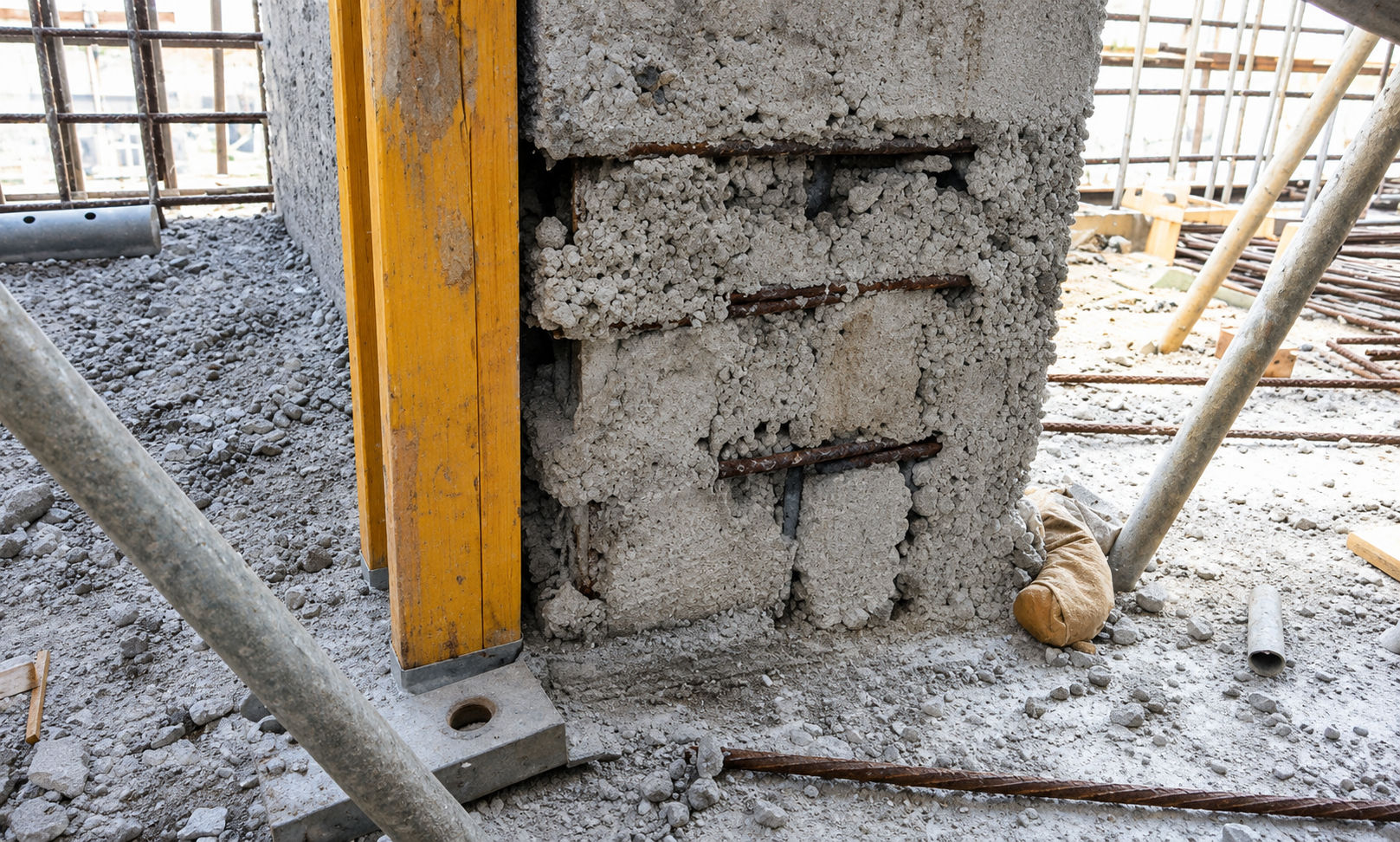
Honeycombing is a concrete defect characterised by visible voids, cavities and exposed coarse aggregates on the hardened concrete surface.
It generally occurs when cement mortar fails to fill the gaps between coarse aggregate particles during concrete placement and compaction.
Properly placed and compacted concrete should form a relatively dense and uniform mass. When air becomes trapped or concrete cannot flow around reinforcement and into formwork corners, voids may remain after hardening.
Common signs of honeycombing include:
Honeycombing can occur in columns, beams, slabs, retaining walls, foundations and other RCC elements.
Understanding the causes is the first step towards preventing this defect.
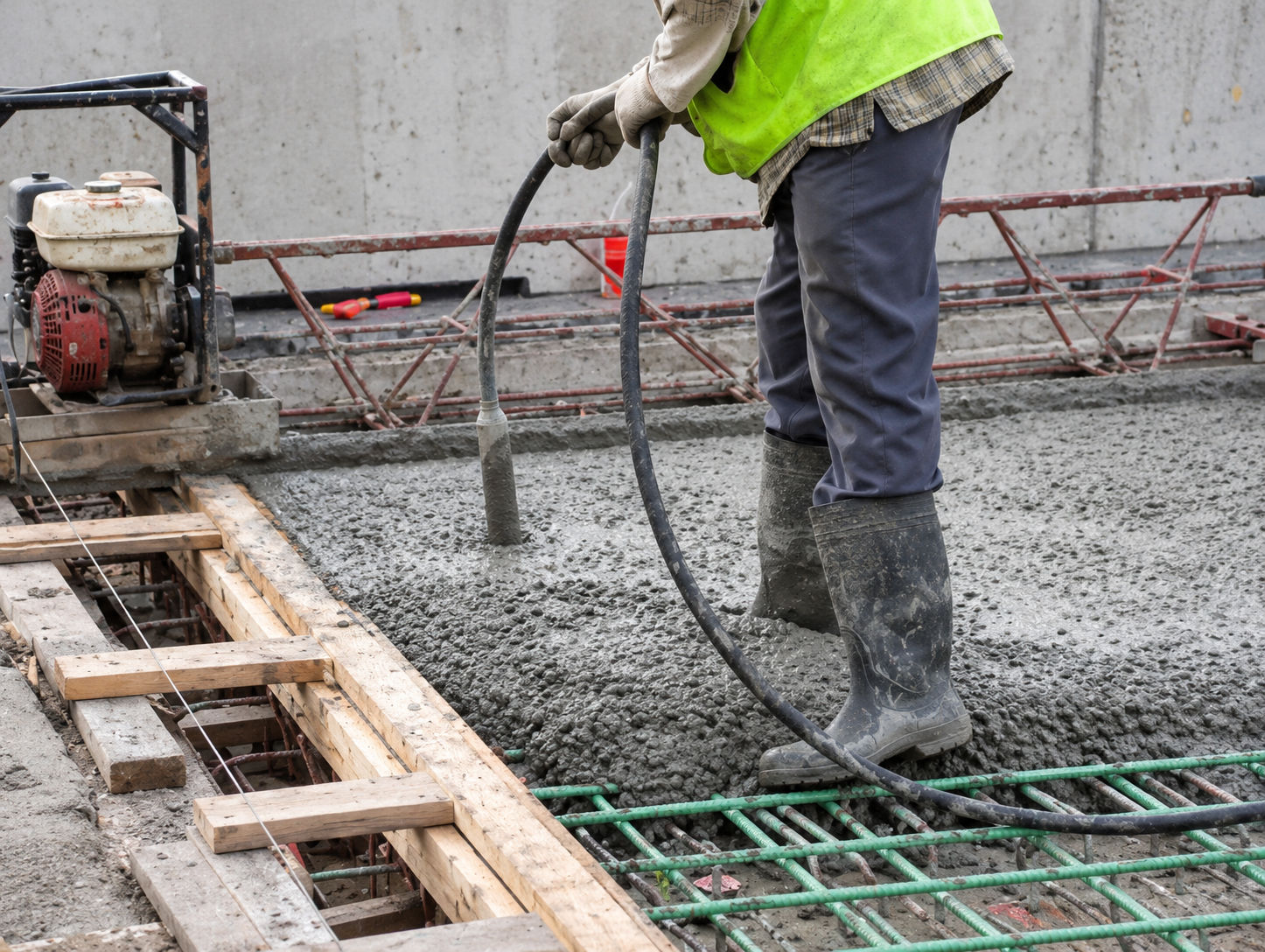
One of the major causes of honeycombing is inadequate concrete consolidation.
When concrete is not vibrated properly, entrapped air remains inside the mixture. These air pockets create voids and prevent the concrete from forming a dense mass.
Using a needle vibrator incorrectly, missing sections during vibration or using unsuitable equipment can contribute to incomplete compaction.
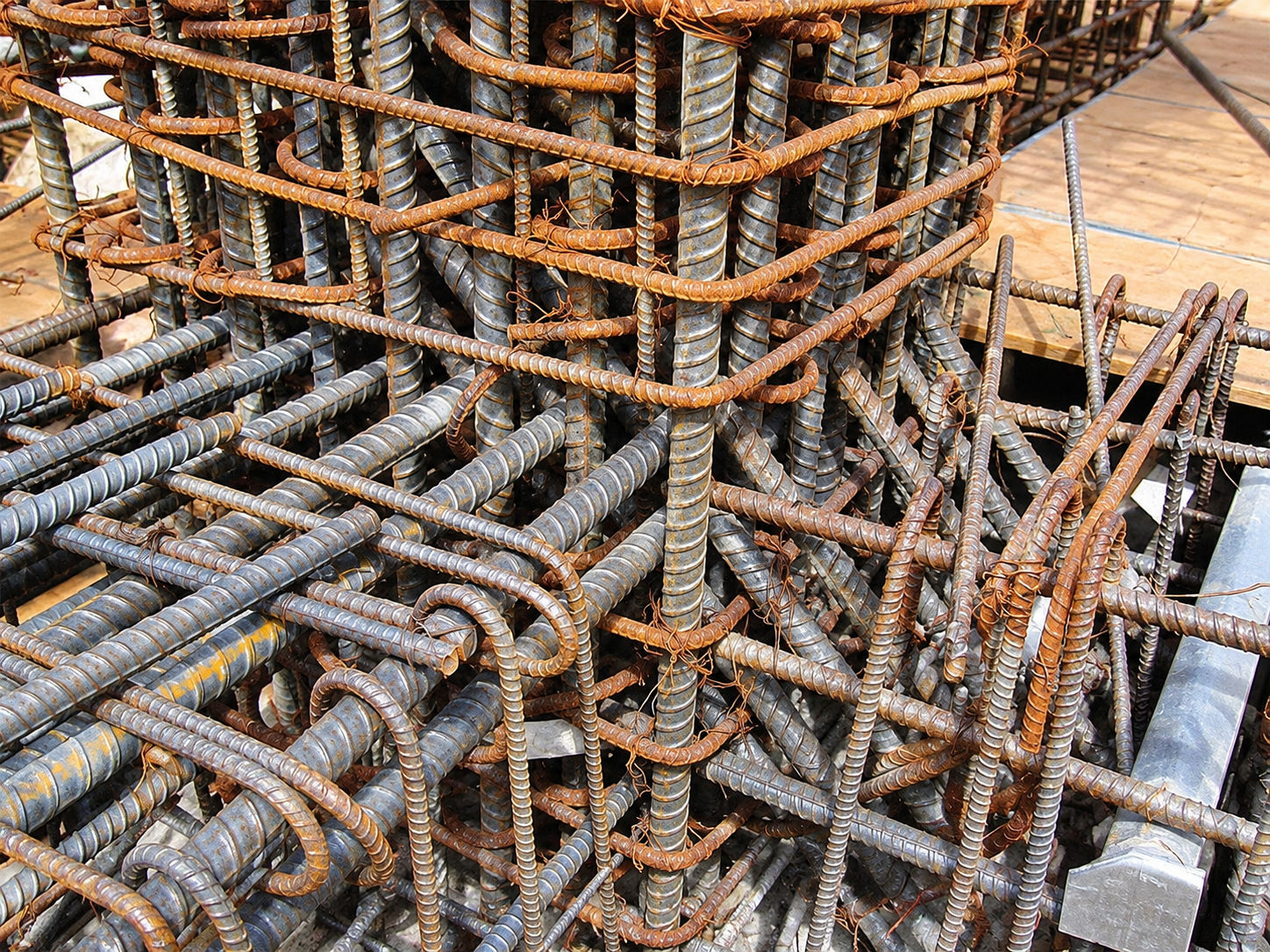
When reinforcement bars are placed very close together, concrete may struggle to pass through the available gaps.
This is particularly common in:
If aggregate size, concrete workability and placement methods are not suitable for the reinforcement arrangement, honeycombing may occur.
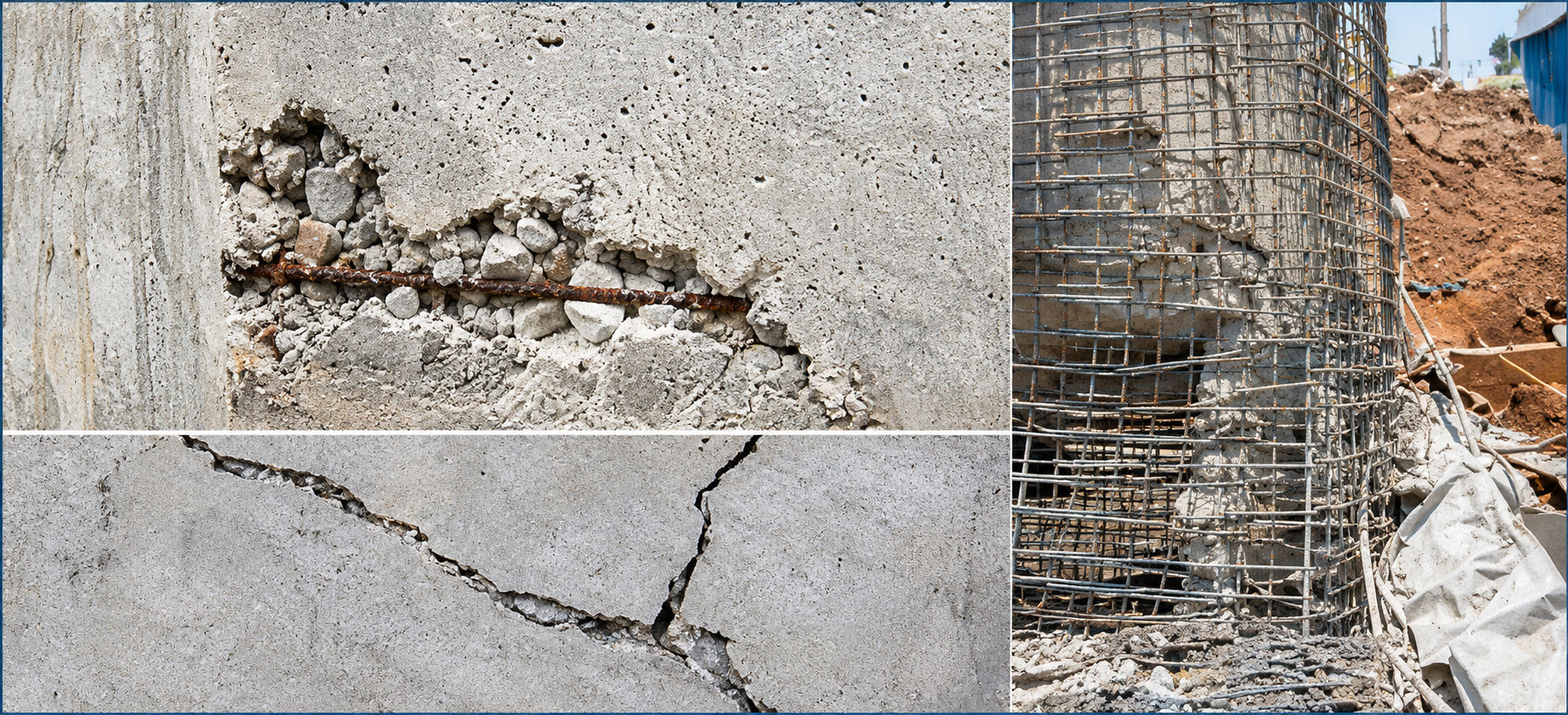
Concrete contains cement, fine aggregates, coarse aggregates and water.
If the mix is not properly designed or proportioned, it may become difficult to place and compact.
For example:
The concrete mix should be designed for the application, reinforcement congestion and placement conditions rather than adjusted randomly at the site.
Dropping concrete from excessive heights or allowing it to accumulate unevenly can encourage segregation.
When coarse aggregates separate from cement mortar, the mixture may become non-uniform.
Other placement-related problems include:
Concrete should be deposited as close as practical to its final position.

Gaps in formwork can allow cement paste and mortar to escape during concrete placement.
As a result, coarse aggregates may remain exposed, producing honeycombed areas.
Before pouring concrete, inspect formwork for:

Using an unsuitable vibrator or depending on inexperienced operators can result in inconsistent consolidation.
If the vibrator cannot effectively cover the concrete section, certain areas may remain under-compacted.
Equipment selection should consider member dimensions, reinforcement spacing, concrete workability and site accessibility.
Preventing honeycombing requires proper planning before pouring, controlled placement and effective consolidation.
Here are six important practices for construction sites.
Use an approved concrete mix design suitable for the structural application.
Check:
Avoid adding excess water at the site simply to make concrete easier to pour. Any workability adjustment should follow the approved mix design and be supervised by the responsible engineer.
Before concrete placement, inspect the reinforcement cage.
Ensure that:
Where reinforcement is congested, coordinate the concrete mix and placement method with the structural engineer.
Needle vibrators, also known as internal or poker vibrators, are commonly used for consolidating concrete in beams, columns, foundations and other RCC members.
Their vibration helps release entrapped air and allows fresh concrete to settle around reinforcement and inside formwork.
However, choosing a vibrator with an appropriate head diameter, frequency and operating characteristics is important.
The equipment must be suitable for the concrete mixture and dimensions of the structural member.
Correct operation is just as important as selecting the right equipment.
Follow these general practices:
The appropriate insertion spacing and duration depend on the vibrator and concrete mixture.
Check all formwork connections and joints before starting the pour.
Make sure:
Concrete vibration should be performed by trained operators under appropriate site supervision.
The supervisor should monitor:
A standby vibrator is also useful on critical pours to reduce disruption if the primary equipment fails.
A needle vibrator must be operated using a systematic method to ensure uniform concrete consolidation.
Here is a practical sequence for site engineers and operators.
Before starting, inspect:
Place concrete in manageable layers according to the structural member, mix and approved method statement.
Avoid placing excessive concrete in one lift where it prevents effective consolidation.
Insert the needle at systematic intervals. The insertion pattern should ensure that the effective vibration zones overlap.
Keep the needle in position until the concrete is adequately consolidated. Watch for changes in the surface and reduction of escaping air bubbles.
Withdraw the needle gradually to allow concrete to close the hole left by the vibrator.
Repeat the process systematically, paying particular attention to corners, reinforcement congestion and areas near formwork.
There is no universal vibration duration suitable for every concrete mix and vibrator.
The required duration depends on:
The objective is to achieve adequate consolidation without causing segregation. Follow the approved concrete placement procedure and the equipment manufacturer's recommendations.
While inadequate vibration can leave air pockets, excessive or inappropriate vibration can also create problems.
Over-vibration may cause segregation, particularly when the concrete mixture is unstable or highly workable.
Possible consequences include:
The objective is not to vibrate concrete for as long as possible. It is to achieve adequate and uniform consolidation without segregation.
After removing formwork, inspect the concrete surface carefully.
Honeycombing can vary from small surface imperfections to deep cavities that expose reinforcement.
Minor defects may involve shallow surface voids without significant loss of concrete section or exposed reinforcement.
After inspection and approval by the responsible engineer, suitable surface repair materials and procedures may be specified.
Serious defects may involve:
These defects should not be concealed with cement slurry or ordinary surface plaster.
A qualified structural engineer should assess the affected member and determine the necessary investigation and repair method.
Depending on the severity, this may involve removal of unsound concrete, reinforcement assessment, specialised repair materials or structural strengthening.
Important: Never assume that a honeycombed column or beam is structurally safe simply because the defect has been covered.
| Parameter | Needle Vibrator | Manual Compaction |
|---|---|---|
| Method | Mechanical vibration | Manual rodding or tamping |
| Application | Suitable RCC sections | Limited applications |
| Compaction consistency | More systematic when properly operated | Depends heavily on worker technique |
| Reinforcement areas | Can consolidate accessible areas with suitable head selection | May struggle to reach all internal areas |
| Labour requirement | Requires trained operator | Requires manual effort |
| Productivity | Generally suitable for larger concrete placements | Can be labour-intensive |
For most conventional structural concrete placements, mechanical vibration is an effective consolidation method. However, the method must be selected according to the concrete design and structural application.
Before starting a concrete pour, use this checklist to reduce the risk of honeycombing.
This checklist can help site supervisors organise pre-pour inspections and monitor concrete placement activities. It does not replace approved structural drawings, specifications or inspection procedures.
Q1. What is the main reason for honeycombing in concrete?
Inadequate concrete consolidation is a major cause. Poor workability, congested reinforcement, segregation and leaking formwork can also contribute.
Q2. Can honeycombing weaken a concrete column?
Yes. Severe honeycombing can reduce the effective concrete section, compromise reinforcement protection and affect structural performance. The extent of the defect must be assessed by a qualified structural engineer.
Q3. Does a needle vibrator prevent honeycombing?
A properly selected and correctly operated needle vibrator helps reduce entrapped air and improve concrete consolidation. However, it cannot compensate for an unsuitable mix design, poor placement or defective formwork.
Q4. How many seconds should a needle vibrator be used at each point?
There is no fixed duration for every application. Vibration time depends on concrete workability, vibrator characteristics and placement conditions. Operators should follow the approved method and assess the consolidation response.
Q5. Can honeycombing be repaired?
Some minor surface defects can be repaired using suitable materials and approved procedures. Deep honeycombing or exposed reinforcement requires engineering assessment before any repair is undertaken.
Q6. Can excessive vibration cause honeycombing?
Excessive vibration can cause segregation, which may result in non-uniform concrete and other defects. Proper vibration technique is essential.
Q7. Which vibrator is suitable for RCC columns and beams?
An appropriately sized internal needle vibrator is commonly used for RCC columns and beams. Its head diameter and performance should be selected based on reinforcement spacing, member dimensions and concrete properties.
Effective concrete consolidation is an important part of achieving good-quality RCC construction.
The right concrete vibration equipment, suitable mix design, proper placement practices and trained operators all contribute to a more uniform concrete structure.
At SONA Construction Technologies Pvt. Ltd., explore construction equipment solutions for professional construction applications.
Before selecting equipment, consider:
Looking for suitable concrete vibration equipment for your project?
Explore SONA's product range and connect with the team for equipment-related enquiries.
SONA Construction Technologies Pvt. Ltd.
Honest Quality. Honest Pricing.
Website: https://sonavibrators.com/
How to Prevent Honeycombing in Concrete: Causes, Proper Needle Vibrator Technique and Site Solutions
Stirrup Bending Machine for Rebar Yards: Calculate Your ROI and Payback Period

Bar Cutting Machine Price in India: GQ40 vs GQ50 vs GQ52 Buying Guide

Why Soil Compaction Fails Even After Multiple Roller Passes: 7 Site-Level Causes and How to Fix Them

Field Density Test (FDT): Methods, Procedure & Calculation

Copyright © 2026 Sona Construction Technologies Private Limited