
.jpg)
You can order M25 concrete, pay for M25 concrete, and still end up with M18 in your structure. The grade on the delivery slip is only a promise. Whether the structure achieves it depends on mix, water, compaction and curing.
This guide explains what each grade means and where to use it. It also covers the part most guides skip: how the grade you choose changes the way concrete should be placed and vibrated.
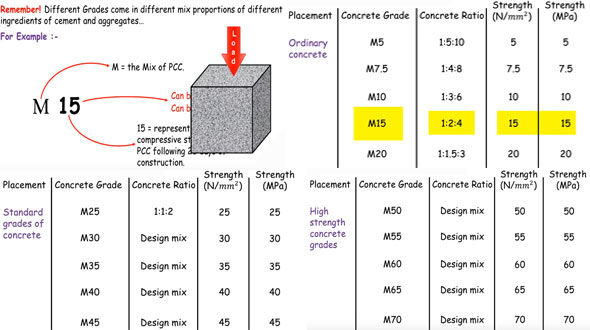
A grade of concrete is its characteristic compressive strength at 28 days, written as M (for Mix) followed by a number in N/mm² (MPa).
In India, grades follow IS 456:2000. In Europe you'll see notations like C25/30, where the first number is cylinder strength and the second is cube strength. Cylinder strength is lower than cube strength for the same concrete, which is why the two numbers differ.
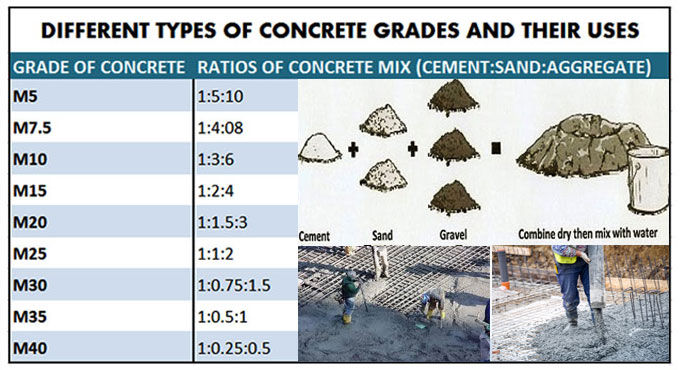
| Category | Grades | Typical use |
|---|---|---|
| Ordinary | M10, M15, M20 | Non-structural and light work, PCC, small footings |
| Standard | M25 to M55 | Most RCC in modern construction |
| High strength | M60 to M80 | Tall buildings, long-span bridges, prestressed members |
Nominal mix uses fixed volume proportions. IS 456 permits it only up to M20.
| Grade | Cement : Sand : Aggregate |
|---|---|
| M5 | 1 : 5 : 10 |
| M7.5 | 1 : 4 : 8 |
| M10 | 1 : 3 : 6 |
| M15 | 1 : 2 : 4 |
| M20 | 1 : 1.5 : 3 |
Design mix is proportioned in a lab for your actual materials, target strength, workability and durability. It is required above M20, and it is usually more economical on bigger jobs because it avoids over-cementing.
| Grade | Strength (N/mm²) | Where it's used |
|---|---|---|
| M5, M7.5 | 5, 7.5 | Leveling courses, filling, blinding |
| M10 | 10 | PCC under footings, light pavements, non-structural flooring |
| M15 | 15 | Plain concrete, boundary walls, small non-structural members |
| M20 | 20 | Residential RCC in mild exposure: slabs, beams, columns, footings |
| M25 | 25 | Standard for most RCC buildings, retaining walls, water tanks |
| M30 | 30 | Multi-storey buildings, roads, parking decks, severe exposure |
| M35, M40 | 35, 40 | Bridges, high-rises, marine and coastal work, pre-tensioned members |
| M45 to M55 | 45 to 55 | Heavy industrial structures, precast elements, long spans |
| M60 and above | 60+ | Skyscraper cores, dams, tunnels, special infrastructure |
The environment sets the minimum grade, along with minimum cement content and maximum water-cement ratio for reinforced concrete.
| Exposure | Min. grade | Min. cement (kg/m³) | Max. w/c ratio |
|---|---|---|---|
| Mild | M20 | 300 | 0.55 |
| Moderate | M25 | 300 | 0.50 |
| Severe | M30 | 320 | 0.45 |
| Very severe | M35 | 340 | 0.45 |
| Extreme | M40 | 360 | 0.40 |
Notice the pattern: as the grade goes up, the water-cement ratio goes down. Lower water means a stiffer, denser mix, and that is exactly where compaction starts to matter.
Always follow the grade on the structural drawings. These notes help you understand the choice, not override it.
Here is what grade tables don't tell you. A mix designed for M30 is not simply "M25 but stronger." It typically has a lower water-cement ratio, more cement and often admixtures. That changes how it behaves under a vibrator.
Why compaction decides your real grade. Trapped air voids reduce strength directly. Roughly speaking, every 1% of unremoved air can cost a noticeable amount of compressive strength. A perfect M30 mix, poorly compacted, can test like a lower grade. The strength is lost in the placing, not in the mix.
How compaction needs change across grades:
| Grade range | Mix behaviour | Compaction approach |
|---|---|---|
| M5 to M15 (PCC) | Wide, shallow pours, little steel | Larger needle or screed work is fine. Main goal is a uniform, level base. |
| M20 to M25 (general RCC) | Moderate workability, reinforcement in beams and columns | Match needle diameter to bar spacing. Insert at regular spacing so vibration zones overlap. |
| M30 to M40 | Lower w/c ratio, often stiffer, usually with plasticiser | Needs consistent, effective vibration. Use a properly sized, high-frequency needle and don't rush insertion. |
| M45 and above | Very low w/c, dense, often with superplasticiser | Short, well-controlled vibration. Under-vibration leaves voids, over-vibration causes segregation. |
Choosing the needle. Smaller needles (roughly 25 to 40 mm) suit thin walls and congested reinforcement. Mid-size needles (roughly 40 to 60 mm) handle most slabs, beams and columns. Larger heads suit mass concrete. The right size is the one that physically fits between the bars and still has enough radius of action.
Radius of action and spacing. Every needle compacts concrete within a certain radius around it, commonly a few times the head diameter, depending on the mix. Insert needles so these zones overlap, and push the needle in vertically and quickly, then withdraw it slowly. Vibrate each point until air bubbles stop rising and the surface looks glossy, not until it "feels" done.
Over-vibration is real. Excess vibration makes coarse aggregate sink while water and fine paste rise. This segregation leaves a weak, laitance-heavy top layer. It is as damaging as under-vibration, and higher-slump or admixture-rich mixes are more prone to it.
Concrete that reaches 25 N/mm² characteristic compressive strength at 28 days on a 150 mm cube.
Yes, 30 vs 25 N/mm², but it costs more and needs better quality control.
M20 or M25 for RCC, and M10 to M15 for PCC under foundations.
Yes. Entrapped air and segregation both reduce the strength the structure actually achieves, regardless of the grade ordered.
No. Higher grades cost more, generate more heat and shrinkage, and need tighter control. Use the grade the design and exposure require.
Grade tells you what the concrete can achieve. Compaction, water control and curing decide what it does achieve. Choose the grade your engineer specifies, then protect it with the right vibrator, the right technique and proper testing.
Need help choosing the right compaction equipment for your pour? Talk to the Sona team to match the needle size and vibrator type to your grade, section and site conditions.
Grades of Concrete (M5 to M80): Uses, Strength and How to Compact Each Grade Properly
Automatic Stirrup Bending Machine: Complete Price & Buying Guide (India)

Rebar Bending Machine Price in India: Types, Capacity, Power & Complete Buying Guide

Sona at bauma CONEXPO INDIA 2026: A Look Inside Stall H14-B55
TMT Stirrup Bending: Machine Bending vs. Manual Bending — Which Is Better?

Copyright © 2026 Sona Construction Technologies Private Limited